
Every wedding photograph has two subjects: the people, and everything behind them. Decor is the everything. It fills the background of the pheras, frames the couple’s entry, and sets the colour of the light on every face in the room. Couples often spend lakhs on decor and minutes thinking about how it will photograph, then wonder why the pictures feel flat or strangely tinted.
The good news is that decor which photographs well is not more expensive decor. It is decor planned with light, colour and camera angles in mind. This guide walks Indore couples through the decisions that matter most, from the stage to the entrance, so the wedding looks as rich in the album as it did in the room.
Light is the first decor decision
Before flowers, before fabric, before the stage design: light. Cameras see light differently from eyes, and the single most common decor problem in wedding photographs is saturated coloured LED light on people’s faces. Deep blue, magenta and red washes look festive in person and turn skin grey, purple or orange on camera.
The fix costs nothing. Ask the decorator or lighting vendor for warm white light on the stage, the mandap and the couple’s seating, and keep the coloured effects for the walls, the ceiling and the dance floor. A pair of warm LED panels aimed at where the couple sits changes every portrait of the evening. Share this preference early, while the lighting plan is still flexible, not on the day.
Choose colours the camera loves
Some palettes photograph richly and some fight the camera. Jewel tones – deep reds, maroons, emerald, royal blue, gold – hold their depth in photographs. Very pale pastels can wash out under bright event lighting, and neon or fluorescent shades reflect their colour onto skin, outfits and white fabric nearby.
Texture matters as much as colour. Layers of fabric, fresh flowers, foliage, candles and lanterns give a camera something to work with: depth, shadow and detail. A flat printed backdrop, however pretty its design, photographs flat. If the budget forces a choice, spend on one richly textured area, usually the stage or the couple’s seating, and keep the rest simple.
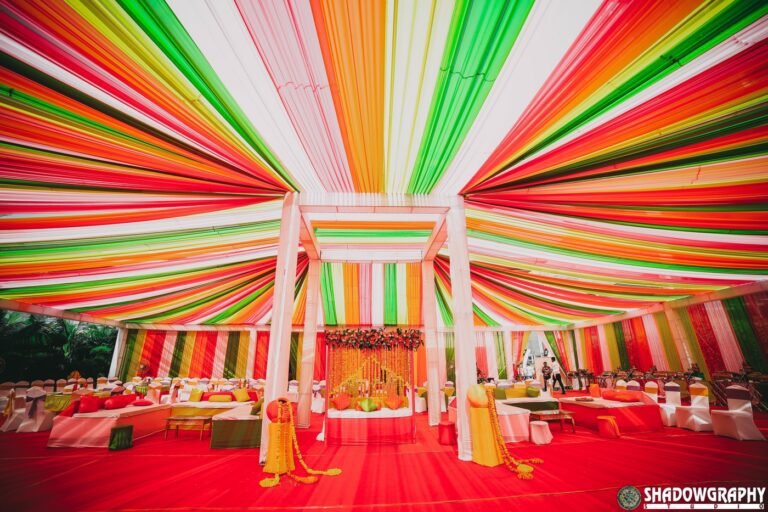
The stage deserves a second look
The stage is the most photographed square metre of the wedding, so inspect it with a photographer’s eye. A backdrop with some depth – panels, floral walls, arches at different distances – gives portraits dimension. A backdrop that sits flush behind the sofa flattens every frame. Height matters too: a stage raised too high hides the couple’s feet and forces unflattering upward angles.
Check what surrounds the stage as well. Speaker stacks, cable runs, fire extinguishers and plastic chairs at the edges wander into wide photographs. Ask the venue to dress or clear a clean margin around the stage, and confirm where the photographer can stand for a straight-on view. Our venue photography walkthrough covers how we scout these angles before the day.
Flowers, fabric and open flame
Fresh flowers photograph with a softness that artificial ones rarely match, especially in close-up frames of the mandap or the couple’s seating. If the budget mixes both, put the fresh flowers where the camera comes closest and let artificial arrangements handle the distance. Draped fabric moves beautifully in photographs but needs to be secured against ceiling fans and evening wind.
Candles and diyas add warmth that no LED replicates, but open flame near fabric, floral foam and flowing dupattas is a real hazard. Keep flame in lanterns or on stable surfaces away from drapes, and tell the photographer where the candle-lit corners are: they make some of the most atmospheric frames of the night.
Do not forget the spaces in between
Some of the day’s biggest photographs happen away from the stage: the couple’s entry, the walk to the mandap, the baraat’s arrival, the first steps into the reception. These transitional spaces are often the least decorated, and the photographs show it. A simple lit pathway, a floral arch or even well-placed lanterns turn a parking-lot walk into an entrance.
Think about these routes at each function, and mention them to your photographer. The sangeet entry, for instance, lives and dies by its lighting and its runway space; our sangeet night photography guide goes deeper on that evening. The reception has its own stage and entry logic, covered in our reception photography guide.
Time the decor, not just the ceremony
Decor is usually finished minutes before guests arrive, which means the couple’s photographs with the decor never happen. The fix is a fifteen-minute window: ask the decorator when the stage and key areas will be camera-ready, and schedule the couple’s portraits immediately after, before the doors open. The room is clean, the flowers are fresh and nobody is waiting on you.
This window belongs in the wedding day schedule alongside everything else; our coverage hours guide shows how the pieces of the day fit together. If your venue allows it, a quick walkthrough with the photographer the evening before – while the decor is going up – catches lighting problems while they can still be fixed.
One conversation, three vendors
The best results come when the decorator, the lighting vendor and the photographer hear the same plan once. A short group conversation or a shared note covering warm light on faces, the couple’s portrait window, clean stage edges and the entry routes prevents nearly every common decor photograph problem. None of it costs more money; it only costs the asking.
You are welcome to browse our wedding portfolio to see how Indore weddings look when decor and photography are planned together. When you are ready to talk through your own functions, get in touch with the studio – we are glad to walk the venue with you.