
Some wedding photographs are impossible from the ground. The full sweep of a decorated venue at night, the baraat winding towards the entrance, the couple framed by the landscape they chose – these frames need height. That is what a drone adds to wedding coverage: not novelty, but perspective.
A drone is not automatically part of every wedding, and it should not be. It earns its place when the venue, the events and the permissions line up. This guide explains what drone photography actually adds, what to arrange before the day, and the questions worth asking before you pay for it.
What a drone adds to a wedding album
The establishing shot is the drone’s signature frame: the whole venue glowing at night, the mandap and the seating laid out below, the approach road lit for the baraat. These images open albums and films the way a film opens – with a sense of place. No ground camera can stand far enough back to take them.
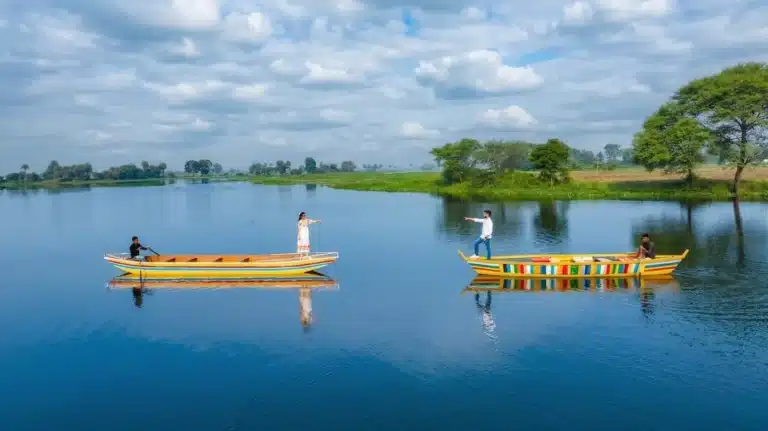
Drones also capture movement beautifully. The baraat’s arrival, the couple’s entry down a long pathway, guests gathering for a group frame – seen from above, these moments gain scale and shape. And for outdoor venues with real landscapes – a lake, a fort, open fields – a drone gives the couple portraits that put them inside the scenery rather than merely in front of it.
Permissions and venue rules come first
Drones are regulated, and venues have their own rules on top. Heritage properties, hotels, venues near airports or government buildings, and some farmhouses all set their own policies, and many require advance written permission for drone flights. The time to find this out is weeks before the wedding, not on the morning of it.
Ask the venue directly: are drone flights allowed, in which areas, and is any approval needed? Share the answer with your photography team early. A professional team plans flights within the rules and carries the discipline to keep the drone away from guests, wires and rituals. If a venue says no, that answer stands – the coverage simply uses other angles, and it loses nothing essential.
Weather, light and timing
Drone flights depend on conditions in a way ground photography does not. Strong wind, rain and dust storms ground the aircraft, and winter fog can hide the very view the flight was meant to capture. Treat drone frames as a bonus the weather can cancel, and make sure the album’s essential photographs never depend on them.
Timing shapes the best aerial frames. The venue reveal works best just after sunset, when the decor lights are on but the sky still holds colour – a window of perhaps twenty minutes. Outdoor couple portraits from above suit the soft light of early morning or late afternoon. Share the day’s schedule with your team so these windows are planned rather than stumbled upon; our coverage hours guide shows how such windows fit into the day.
Safety is part of the craft
A drone over a wedding is an aircraft over a crowd, and it should be flown like one. That means a dedicated operator who is not simultaneously shooting stills, flight paths that avoid hovering over guests, distance from havan fire, fireworks and cold pyros, and complete silence during rituals where the sound would intrude. Modern drones are quiet, but quiet is not silent.
It also means knowing when not to fly. During the pheras, over the dining area, or in a packed hall with a low ceiling, the drone stays down. The team’s judgement here matters more than the machine; our guide to how wedding photography teams work explains how roles like a dedicated drone operator fit into coverage.
When a drone is worth it – and when it is not
A drone earns its place at open venues: farmhouses, lawns, lakesides, heritage properties, large banquet grounds, and any wedding where the setting is part of the story. It adds the least to a compact indoor hall, where everything that matters happens within four walls and a ceiling blocks the sky.
Think in terms of the album you want. If you imagine a sweeping night view of your decorated venue, a baraat seen from above, or portraits inside a landscape, plan for drone coverage and arrange the permissions early. If your venue is intimate and indoors, invest the same attention in the photography itself. Our venue photography walkthrough can help you read your own venue’s possibilities.
You are welcome to browse our wedding portfolio to see how aerial frames sit alongside the day’s quieter moments. When you are ready to plan your coverage – drone or otherwise – get in touch with the studio and tell us about your venue.