
“Hum pose nahi kar paate” – almost every couple says this before their pre-wedding shoot, and almost every couple is wrong an hour into it. The truth a photographer learns early: the best pre-wedding poses are not performed, they are prompted. Nobody holds a stiff position and looks in love. Couples walk, talk, laugh at an inside joke, and the pose happens inside the movement.
Still, it helps to arrive knowing the classic frames – the ones that work for every couple, at every Indore location. This guide covers those poses, what to do with your hands and eyes, and how to feel at ease even if you have never faced a camera together.
The poses that always work
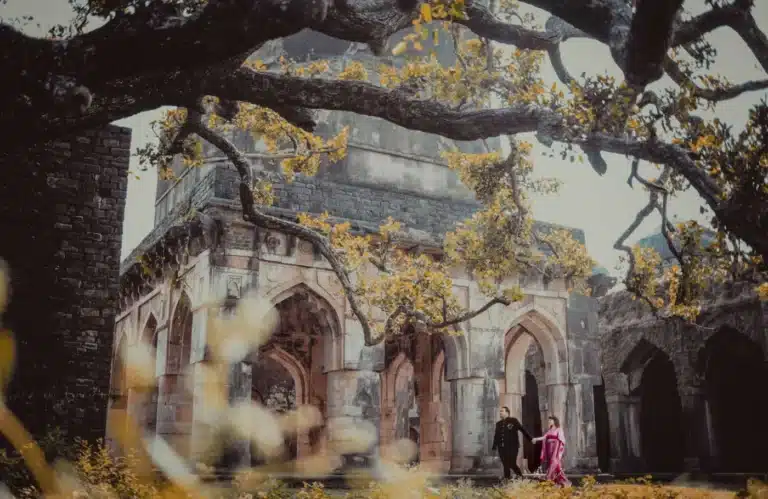
The walk. Hold hands and walk, slowly, talking to each other – not to the camera. Heritage arches, palace corridors and tree-lined paths are built for this frame. Walk towards the camera, away from it, and across it. Every variation gives a different story, and because you are moving, nobody looks stiff.
Face to face. Stand close, forearms or hands touching, and simply look at each other. The conversation you have in that moment writes the expression – say something funny, or say nothing. This is the frame families choose for the invitation card.
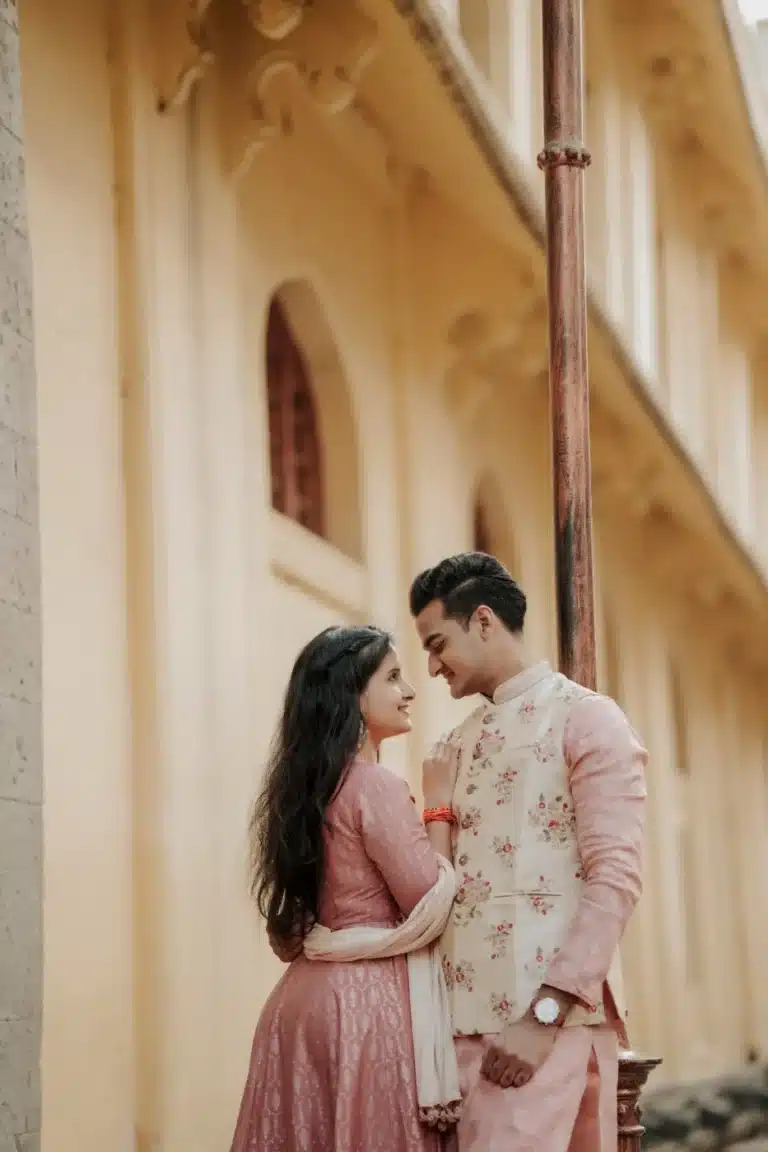
The forehead touch. Eyes closed, foreheads together, anywhere – a boat, a doorway, a garden bench. It reads as tenderness in every light and needs zero acting skill.
The twirl. She twirls, he watches and smiles. The outfit does the work here – a flowing lehenga, gown or saree creates the motion the camera loves.
The dip and the lift. The classic film-frame finish – he dips her back, or lifts her, both laughing. Do this once, at the end, when you are relaxed; it is the pose that most rewards confidence and punishes hesitation.
Seated together. On steps, a boat, a low wall – sitting removes the awkwardness of standing and gives hands a natural place to rest. Lean on each other, share a look, share a laugh.
Hands and eyes: the two things couples ask about
Hands feel awkward only when they have nothing to do. Give them a job: hold hands, fix his collar, adjust her earring, carry a dupatta, rest on a railing. As our pre-wedding props guide shows, even a simple prop solves the hands question instantly.
Eyes are easier than couples think. Looking at the camera is only one option among many – look at each other, look at where you are walking, close your eyes entirely. A good rule: the camera is a guest at your moment, not the host.
A little practice goes a long way
Spend one evening at home with the mood board: stand the way the couples in your references stand, notice where their hands and eyes are, and feel how unnatural it is for exactly ten seconds – that is how long a pose takes to settle. Couples who rehearse even briefly arrive relaxed, and the first hour of the shoot stops being a warm-up.
For camera-shy couples
If posing feels unnatural, skip poses entirely and take prompts instead: whisper the worst joke you know, walk and race each other the last ten steps, tell her the thing you liked most when you first met. Real reactions follow, and real reactions photograph better than any practiced pose. Our natural pre-wedding photos guide goes deeper into this approach – it is how most of our favourite frames actually happened.
Match the pose to the place
Heritage sites like Mandu and Maheshwar reward walks, silhouettes in archways and wide frames where the monument shares the stage. Lakes and gardens suit seated and boat poses. Indoor sets carry the formal frames – the face-to-face, the seated portrait, the dramatic dip. Plan two or three poses per location instead of forcing every pose everywhere; the mood board exercise is where this matching happens, before the shoot day.
One practical note: poses involving movement need outfits that move – check that a lehenga allows a twirl and a sherwani allows a walk. The fabric and fit logic is in our pre-wedding outfits guide.
You are welcome to browse our pre-wedding portfolio and spot these poses in real shoots. When you are ready to try them yourselves, get in touch with the studio – we will guide you through every frame, prompt by prompt.