
Pre-wedding shoot props work best when they give you something natural to do or say something real about your relationship. A book you both love can make more sense than a suitcase bought only for one photograph. A small bunch of flowers can help with a simple portrait, but a pile of unrelated accessories can pull attention away from the people in the frame.
For couples planning a pre-wedding shoot in Indore, the useful question is not how many props to bring. It is which item supports your idea without making the session awkward, unsafe or slow. This guide explains how to choose, prepare and use props while keeping the photographs about you.
1. Choose a reason before choosing an object
Ask what the prop adds. Does it connect to a shared hobby, help you interact or create the colour and movement you want? If the answer is only that someone else used it, pause before buying it.
A personal item can support a small scene. Read a favourite passage together, share a familiar game or arrange a simple picnic if that feels like you. The action matters more than holding an object towards the camera.
You do not need to reveal private memories to make photographs personal. Tell the photographer enough to understand the idea and explain any limits on photographing written messages, names or other details. You can keep a letter closed or use a blank page if its contents should remain private.
2. Compare practical pre-wedding shoot props
These are creative starting points, not a shopping list or a statement that the studio supplies them. Discuss availability and any extra costs before the session.
| Prop | Possible use | Check first |
|---|---|---|
| Book or handwritten note | A quiet shared moment | Privacy, readable details and wind |
| Small bouquet | A hand-held portrait detail | Size, colour and easy handling |
| Musical or hobby item | A scene linked to your interests | Transport, fragility and whether it suits the setting |
| Picnic accessories | A relaxed seated scene | Permission, clean ground and packing everything away |
| Loose fabric | Colour and controlled movement | Helpers, snagging, weather and safe footing |
| Vehicle | A travel-themed portrait | Owner consent, access and a safe stationary setup |
Choose the simplest version that does the job. A compact object that fits in one bag is easier to manage than a large setup requiring repeated assembly. That can leave more time for photographs without props.
3. Keep the couple as the main subject
Give each prop a short purpose within the session rather than using it in every frame. Begin with the planned scene, then put the item aside and make clean portraits. This gives the gallery variety and avoids having an accessory obscure faces, hands or clothing throughout.
Consider scale. A bouquet that looks modest on a table may hide much of your torso when held close. A large sign may dominate a portrait even if its message is meaningful. Let the photographer see the actual item or a clear photograph of it before deciding how to frame it.
Keep text-led props limited. A photograph can communicate connection without a written label explaining it. If you use a sign, check its spelling and whether you want the date or names visible in publicly shared images.
4. Match props to outfits and the background
Think about colour, texture and shape together. A bold accessory can work against a quiet background, but several strong colours may compete. You do not need exact matching. You need a combination in which the item supports the people rather than taking over the photograph.
Send outfit and prop references together. The photographer can assess whether a fabric, bouquet or object disappears into the setting or creates an unwanted distraction. Our pre-wedding outfit guide helps you plan clothing that is comfortable and consistent with the scene.
Do not buy several replacements before discussing the plan. Start with what you already have, then decide whether a missing piece genuinely changes the result.
5. Treat flowing fabric as a setup, not a shortcut
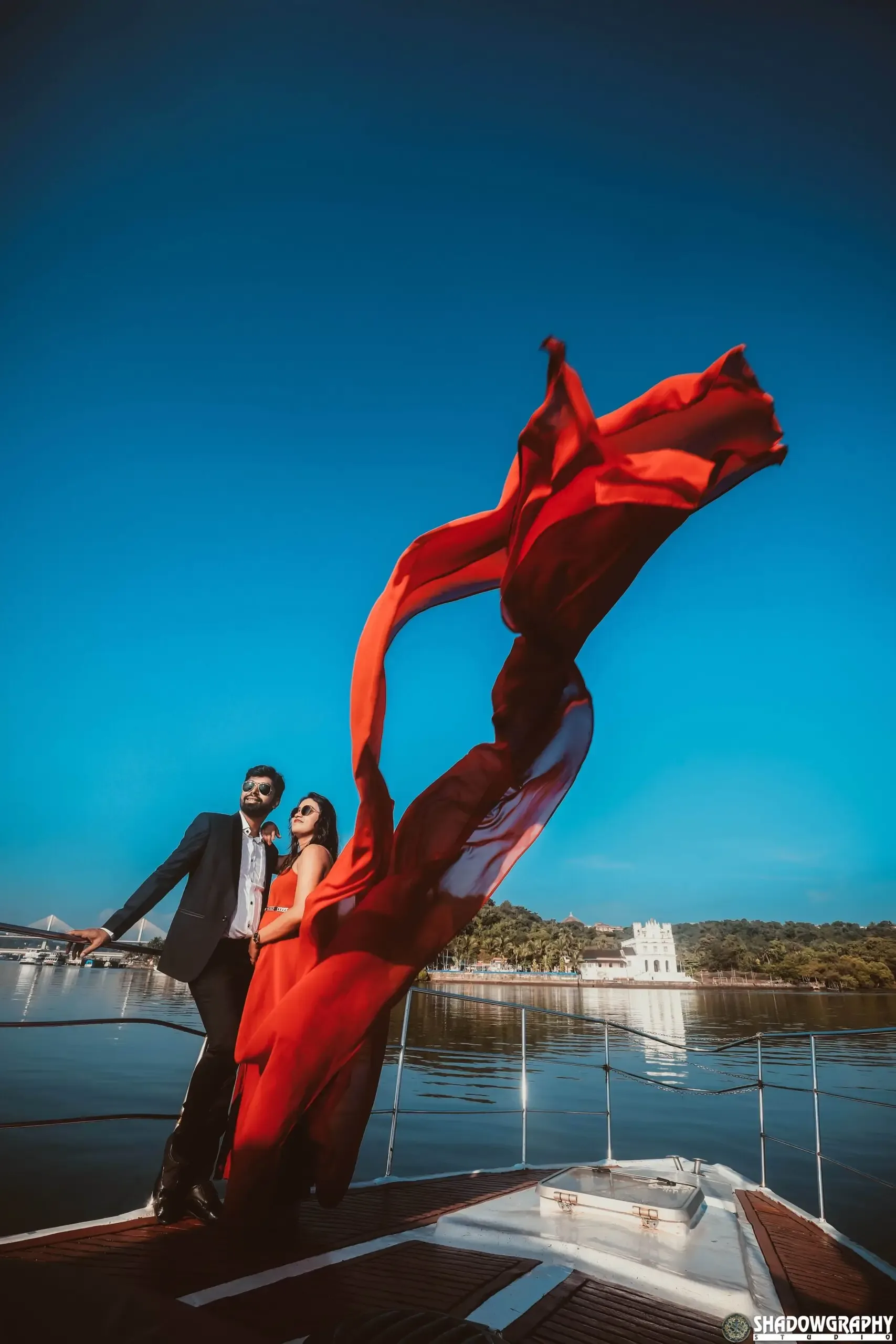
A long piece of fabric can add shape and motion, but it needs space and control. Discuss who handles it, where it can move and how the couple remains steady. The photographer may need assistance to arrange the material without interrupting the frame.
Keep fabric away from faces, moving vehicles and equipment. Watch for snagging and trip hazards. Do not stand close to an exposed edge or enter unsafe water to imitate a reference photograph.
Strong wind is not automatically useful wind. If conditions make an accessory difficult to control, use a simpler arrangement or leave it out. A safe, composed portrait is more valuable than forcing an effect that the conditions do not support.
6. Practise the interaction without rehearsing every expression
Try handling the item at home. Can you sit comfortably with it, open it easily or pass it to your partner? Small practical checks help you notice sharp edges, loose pieces or a position that makes your hands awkward.
Keep the action simple. Talk about the book, share the flowers or do something familiar with the hobby item. You do not have to repeat a complicated performance until it looks spontaneous.
If a prop makes you feel self-conscious, put it aside. It is optional. Our natural pre-wedding photo guide offers ways to use conversation and movement without relying on accessories.
7. Confirm permission and leave the location clean
Tell the location operator about anything beyond ordinary clothing and hand-held items. Large installations, vehicles, food setups or other special arrangements may need separate approval. Do not assume general photography permission includes every concept.
Keep the plan free of uncontrolled flames, pyrotechnics or items that can become litter. Do not release balloons or leave confetti, fabric, packaging or food behind. If an effect creates a cleanup or safety problem, choose another way to make the photograph.
For a vehicle concept, agree a safe stationary setup away from traffic with the responsible owner and operator. Do not ask the couple to improvise poses in a live road. Our location planning guide explains access, facilities and backup checks.
8. Decide who carries, sets up and takes the props home
Assign responsibility before the session. An item that arrives without a stand, a missing part or someone able to carry it may never be used. Keep valuable or borrowed belongings with a trusted person whenever they are not in the photograph.
Ask whether the crew is providing any accessory or assistance, and confirm the terms. A reference in a portfolio does not prove that the same vehicle, set or prop is included in your booking.
Allow setup and packing time in the route. If a concept takes longer than expected, prioritise the main photographs and reduce optional scenes rather than rushing the couple or skipping a safety check.
A small packing checklist
- One or two selected props with a clear purpose.
- All required parts and protective packaging.
- A photo of the intended outfit and accessory combination.
- Permission for any special setup.
- A named person responsible for handling and returning items.
- A bag for packaging and other waste.
- A simpler version of the scene if conditions change.
- Privacy instructions for letters, names and personal details.
Keep the final plan short enough to use. You should know what each item is for, when it appears and what happens if it is not practical on the day.
Frequently asked questions
Do we need props for a pre-wedding shoot?
No. Interaction, expression and the setting can carry the photographs without accessories. Use a prop only when it adds something you value.
How many should we bring?
A small, purposeful selection is easier to handle than several unrelated items. Discuss the session length and setup needs with the photographer instead of using a fixed number as a rule.
Does the photographer supply props?
Confirm what is included in your own booking. Do not assume that everything visible in a portfolio is supplied or available for your date.
Can props help camera-shy couples?
A familiar object can give you something natural to interact with, but an awkward accessory can have the opposite effect. Choose comfort and be willing to leave it out.
Make the idea personal, not complicated
Explore Shadowgraphy Studio’s pre-wedding photography portfolio and discuss a simple concept that fits your interests, outfits and location. A useful prop supports the moment. It does not need to become the reason the entire session exists.
Further reading: WedClick’s pre-wedding props guide and LL Studio’s guide to using props. This article offers planning ideas, not an included-props list or location policy.