
Ask married couples which wedding photographs they return to most, and the answer is rarely a posed portrait. It is the quiet frame of the lehenga hanging by the window before anyone touched it, the grandmother’s hands fastening a necklace, the rings resting on the invitation card that started everything. These are detail photographs, and they carry the texture of the day long after the noise fades.
Detail shots do not happen by accident. They happen because someone gathered the right things, in the right place, with a little time to spare. This guide explains what detail photos are, what to prepare on the bride’s side and the groom’s side, and how a small amount of planning turns scattered belongings into some of the most loved images of the wedding.
What counts as a detail photo
Detail photography covers everything you chose, wore, carried or were given: the outfits, jewellery, rings, footwear, invitations, perfume, watch, kaliras, and family heirlooms. It also covers the small scenes around them – the makeup brushes laid out, the haldi paste in its bowl, the sherwani buttons being closed.
These images do three jobs in a wedding album. They open the story, showing the day before people fill the frame. They preserve choices you spent months making, often for the only time those things will all be together. And they give the album its rhythm, letting it breathe between the big ceremonies and the portraits.
The bride’s side checklist
Collect the bride’s details in one box or bag the night before the wedding, and keep it in the room where she will get ready. A typical list includes the lehenga or saree on a good hanger, the blouse, dupatta, full jewellery sets including rings, bangles, kaliras and payals, footwear, perfume, the wedding invitation suite, and any heirloom pieces such as a mother’s dupatta or a grandmother’s bangle.
Two additions are easy to forget. First, the engagement ring, which usually lives on a finger during the getting-ready chaos; decide who keeps it safe for the morning photographs. Second, anything with a story: a handwritten note, a gift from the groom, a piece of fabric from a parent’s wedding. Photographers treasure these, because they turn a pretty flat-lay into a family memory.
The groom’s side checklist
The groom’s list is shorter but just as worth preparing: the sherwani or bandhgala on a hanger, safa and kalgi, stole or dupatta, juttis or mojaris, watch, cufflinks, perfume, ring, and any ceremonial items such as a sword or sehra. If the outfit has fine embroidery or buttons, hang it somewhere with natural light rather than leaving it in a garment bag.
The groom’s details are often photographed quickly between events, so preparation matters even more here. When everything is together and accessible, ten minutes is enough. When the watch is in one room and the juttis in a suitcase somewhere else, the moment usually gets skipped, and the album loses half the story.
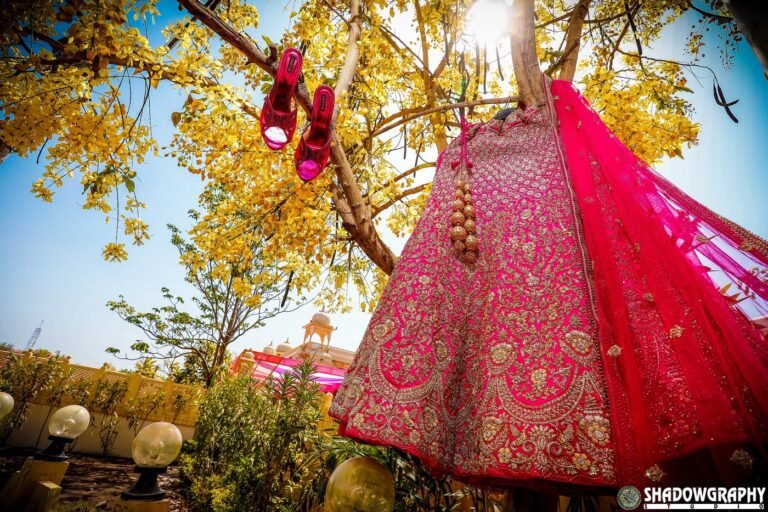
Timing: the quiet hour that pays for itself
Detail photographs usually happen early, while hair and makeup are underway. The bride is occupied, the outfits are untouched, and the light near windows is soft. This is the ideal window, and it costs the couple nothing because it runs in parallel with the morning’s routine.
The practical rule is simple: have the details box ready before the photographer arrives, and tell them where it is. Do not wait to be asked. On a busy morning, a photographer who has to hunt for the rings loses the light, and the couple loses the photographs without ever knowing they were possible.
How photographers style the small things
Detail images are built from natural light, clean surfaces and context. A windowsill, a plain wall, the fabric of the outfit itself – these become backgrounds. Rings rest on invitation cards, perfume bottles sit beside bangles, the sherwani hangs where the light falls across its embroidery. The styling takes minutes when the items are gathered and the room is tidy.
You can help by keeping one corner of the getting-ready room clear of bags, bottles and phone chargers. The photographer will find the rest. If the venue room is dark or cluttered, mention it when planning; a good photographer will scout a balcony, a courtyard or a corridor with better light, as we describe in our venue photography walkthrough.
Where detail photos live in your album
When you sit down to choose photographs for the album, details are the images that make spreads feel designed rather than assembled. An opening page of the lehenga, the rings and the invitation sets the day’s tone before a single face appears. Small frames of the juttis or the kalgi fill the spaces between ceremonies. Our guide to choosing photos for your wedding album explains how to balance these quiet frames with the big moments.
Details also connect naturally to the getting-ready coverage that follows them. The same morning that produces the hanging sherwani produces the fastening of its buttons; our bridal getting-ready photos guide covers how that part of the morning flows.
A five-minute habit that protects the photographs
The single most useful thing a couple can do is this: the night before the wedding, put every detail in one place, tell one person where it is, and mention it to the photographer in the morning. Five minutes of gathering protects a whole category of photographs that cannot be recreated later, because the next day the lehenga will be worn, the flowers wilted and the moment gone.
You are welcome to browse our wedding portfolio to see how detail photographs open and pace our Indore wedding albums. When you are ready to plan your own coverage, get in touch with the studio – we are glad to talk through the morning with you.